
-
Nearly every child in Pairborn was born within the Hall of Mothers under the care of the township's Hearth Mothers. More than midwives, they guided expectant mothers through pregnancy, childbirth, and the early years of raising each pair.
Births traditionally took place in the Hall's circular birthing pool. Following each delivery, detailed records were preserved, including the children's names, locks of hair, ink impressions of their feet, and an impression of the placenta.
The birth of a Single was met with quiet grief. Believed to have lost their twin through reabsorption before birth, these children occupied a unique place within Pairborn society. Hearth Mothers remained with the family long after delivery, helping parents reconcile the loss of the missing twin.
-
From an early age, twins were encouraged to think, play, and learn as a pair rather than as individuals. Childhood was viewed as the period in which the dyad bond was either strengthened or neglected, and parents were expected to foster cooperation above independence.
Pairborn tradition held that twins who learned to function as a single unit gradually strengthened their dyad bond, developing an almost instinctive awareness of one another. A common belief held that every pair naturally divided into complementary roles, with one child becoming more reserved while the other grew increasingly outgoing. Rather than discouraging these differences, families deliberately nurtured them as essential parts of a complete pair.
This philosophy shaped daily life. Twins completed school assignments together, shared responsibilities at home, and were rarely encouraged to compete with one another. Success was measured not by individual achievement, but by the strength of the pair.
-
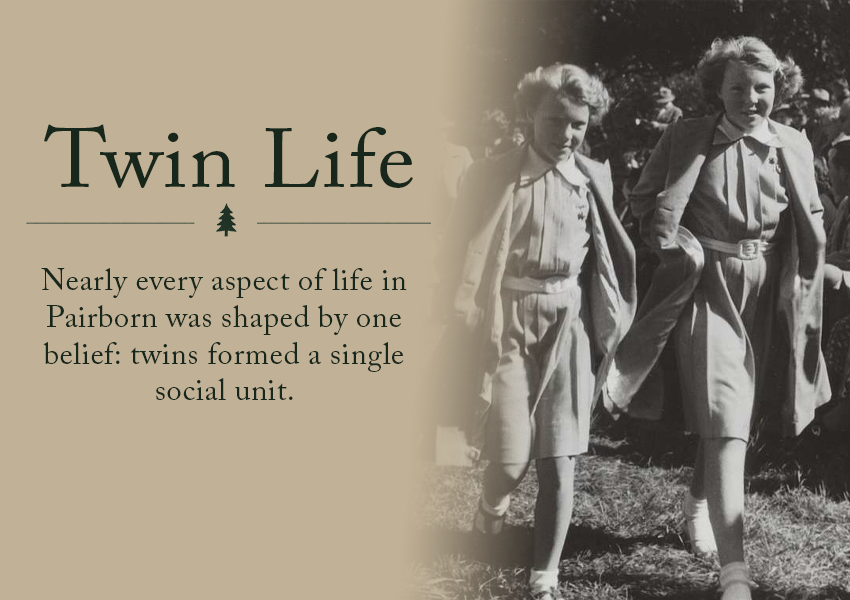
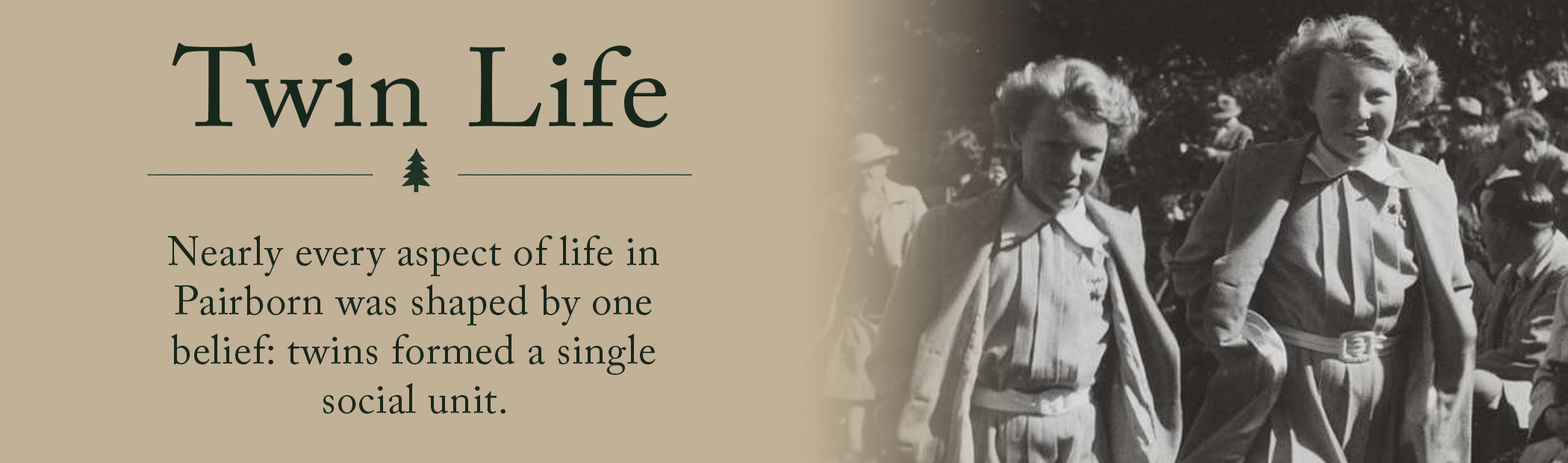
For much of Pairborn's history, twins were expected to dress identically. Matching clothing reinforced the belief that a pair should be recognized as a single social unit, strengthening the dyad bond while discouraging individual expression.
By the latter half of the twentieth century, this tradition gradually softened. While many pairs continued to dress alike, younger families increasingly allowed older children greater freedom in how they dressed.
-
Twins were encouraged to learn the same trade and, whenever possible, work side by side. In the township's logging camps, many pairs spent their lives working together, where their coordination was regarded as one of their greatest strengths.
By the late twentieth century, pursuing separate careers became increasingly accepted, though many pairs continued to work alongside one another.
-
Pairborn placed few formal restrictions on courtship, but the pair always remained at the center of family life. Marriage was expected to strengthen the community without weakening the bond between twins, and spouses entered households where the pair was understood to be the family's enduring foundation.
It was widely believed that the strongest marriages were those that respected the dyad bond rather than competing with it. For most residents, devotion to a spouse and devotion to a twin were never considered opposing commitments.
-
Pairborn's dead were not buried beneath the ground, but sealed within the trunks of living trees in a tradition known as tree-bounding. The practice began out of necessity, when frozen winter ground often made graves impossible to dig, but over generations it became the township's most sacred funerary custom. Twins were always tree-bound with their twin rather than their spouse, and larger trees often became the resting place of multiple generations. Pairborn believed the living tree gradually learned the bodies entrusted to it, returning each pair to the forest and, in time, to the All.
-
Every few years, a child was born without a twin. Pairborn believed the missing sibling had been reabsorbed before birth, leaving the surviving child without their natural pair. Though regarded with sympathy and raised as members of the community, Singles occupied a distinct place within Pairborn society.
They attended the same schools, learned the same trades, and often married, but many customs built around the pair could never fully include them. Children sometimes ostracized their Single classmates, who completed schoolwork alone while twin pairs worked together. In death, Singles were tree-bound with other Singles rather than with a twin. Though accepted as members of the community, they remained a quiet reminder of a bond believed to have been lost before birth.